🟣 Your MCP Strategy Is an Audience Strategy
If your content is unique enough, your MCP becomes one of your most important audience channels. Here's how to decide, build, and sell it.


My family has this tradition of doing Thanksgiving dinner the weekend before the Thanksgiving holiday. It started to help everybody juggle busy schedules with other family obligations and is now turned into an annual family tradition that we've been running for the past few years.
All that means I spent a decent amount of time at airports between Chicago and Charleston this past weekend and put together my thoughts on the how the next iteration of audience development could/should function.
Every publisher is about to ask whether it needs an MCP. There's a better question to answer first: is your content good enough that someone would want it inside their daily work?
An MCP, short for Model Context Protocol, is the open standard that lets AI tools like Claude, ChatGPT, and Copilot connect to outside sources. A publisher that offers one lets its audience ask questions inside their AI tool and get answers built from the publisher's content, with links back to the source.
Politico just became one of the first publishers to turn this into its own product. It's testing an MCP for its Pro Energy subscribers that brings its reporting into Claude, ChatGPT, and Copilot. Access follows each organization's subscription, and subscribers can set up agents that run questions for them on a schedule. Jacob Donnelly argues at A Media Operator that this is the right approach, because publishers can keep blocking AI crawlers and still show up in the chat on their own terms.
I have to imagine this same conversation is happening inside media companies everywhere right now. There are no case studies yet. So this is a framework: how to think about an MCP as it relates to your content, your audience, and your subscriptions.
To make it concrete, I'll use an example you already know: this site. Let's pretend Audience Insiders is a much bigger business than it is and not a random side project. Pretend it's been around for 10 years, has 40,000 newsletter subscribers, a directory of about 2,500 media technology vendors, an annual salary and benchmark survey for audience teams, an archive of operator interviews that lists each publisher's full tech stack, and two events a year. Its readers are people like you: audience, marketing, and product leaders at media companies. Every number in this example is made up.
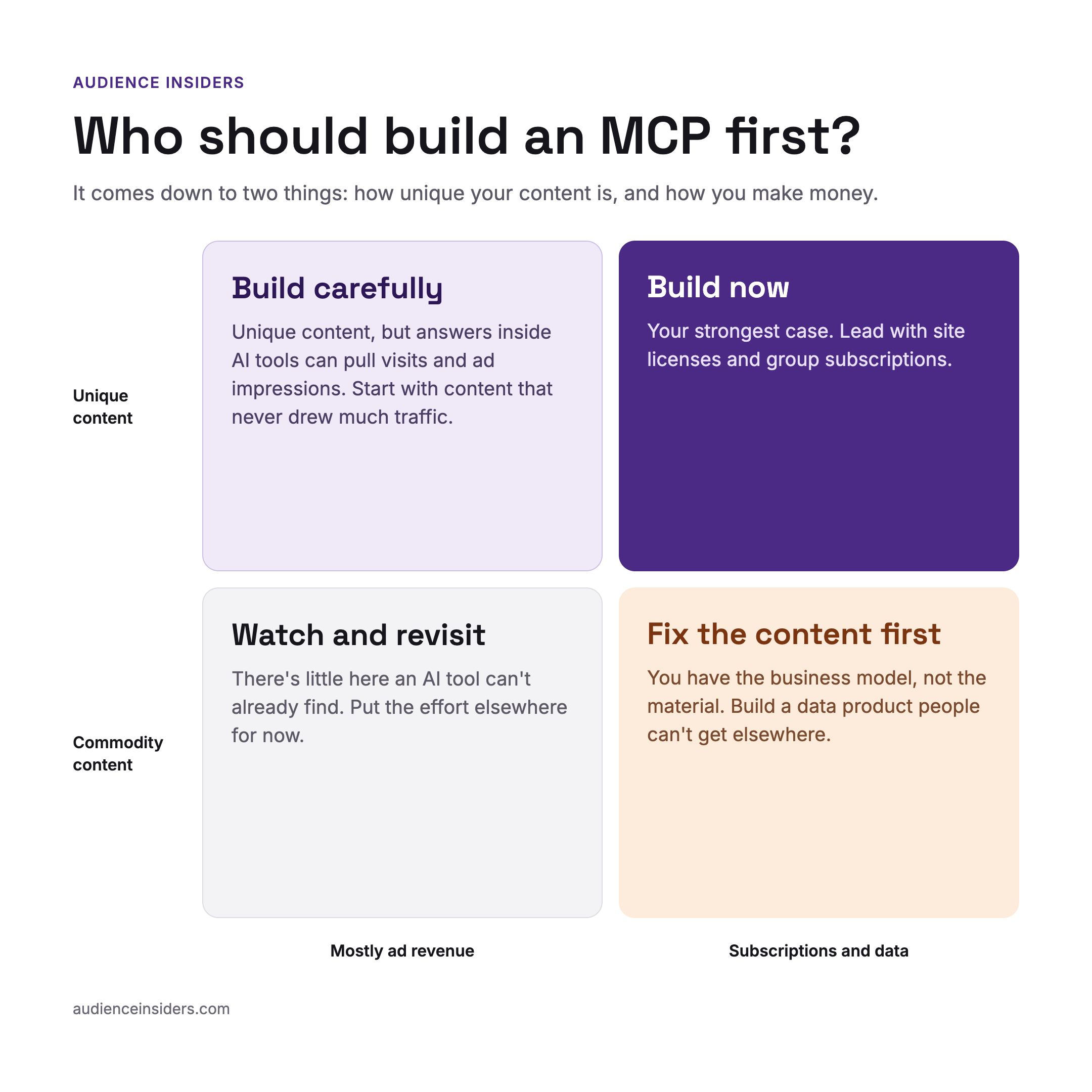
My short answer to whether your MCP strategy is now your audience strategy: for some publishers, it's about to become one of the most important parts of it. For many others, it's worth watching for now. The difference comes down to three tests.
Do you need one?
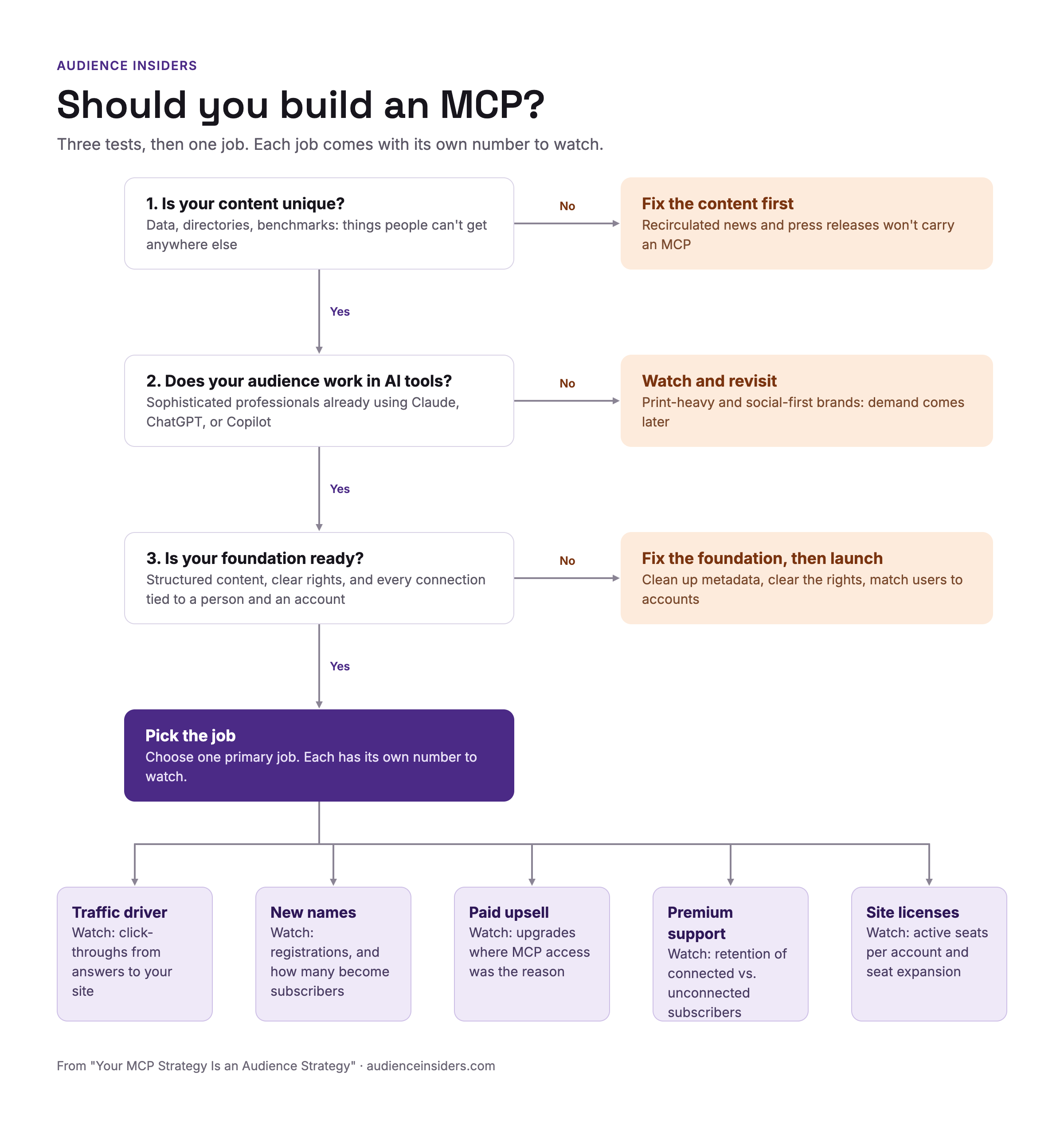
The content test. If you're recirculating the news, rewriting press releases, or covering what people can get anywhere else, an MCP won't help you much. Nobody needs to connect a source to their AI tool when the AI tool already knows the same things.
The publishers who should move first have information people can't get anywhere else. Data products are the clearest example. Directories, earnings reports, databases of people and companies, pricing data, benchmarks, research. This is the kind of content that becomes more useful when someone can ask questions of it, combine it with their own work, and pull it into a report.
Pretend Audience Insiders' weekly commentary on industry news fails this test. You can find takes on the same stories in a dozen other newsletters. The vendor directory, the salary benchmarks, and the tech stack data from the interviews pass easily. Nobody else has them in one place.
The audience test. Think about how your audience likes to engage with your brand today. A sophisticated professional audience that already lives in AI tools at work is a strong fit. If you're still a heavy print subscription brand, or most of your engagement happens on social, you probably won't see much MCP demand early on. That can change. It's just not where to start.
Audience people already use Claude and ChatGPT every day to draft emails, analyze data, and compare vendors. Some of you probably have one open right now. That's a strong fit.
The readiness test. An MCP is only as good as the content underneath it. Four questions decide whether you're ready:
- Is your content structured? Directory records, data sets, and archives need clean fields, consistent categories, and good metadata. An AI tool can only answer well from content it can understand.
- Do you have the rights? Freelance work, syndicated content, and licensed data may not be yours to put into an MCP. Check your contracts before you build.
- Do you know who's connecting? Every connection should tie back to a registered user. For site licenses, it also has to tie back to a company, which means matching individual users to the right account.
- Can you keep it current? Stale data inside someone's daily workflow does more damage than stale data on a page nobody visits.
This is where pretend Audience Insiders has work to do. Its directory categories were added by different contributors over 10 years and don't match. The salary survey lives in PDFs. Some interviews came from guest contributors with old agreements. And tech stacks change every time a publisher switches vendors. None of that is fatal, but all of it comes before launch.
If you pass the first two tests, the third is your to-do list. If you don't pass the first two, your first job is the content itself.
Decide what job it does
Before anyone builds anything, decide what you expect the MCP to do for the business. There are five realistic options, and each one comes with a different number to watch:
- A traffic driver. Answers link back to your stories, and some of those clicks come home. Measure click-throughs from answers to your site.
- A source of new names. People who never came through your usual channels register to use it. Measure registrations through the MCP, and how many become newsletter subscribers or paid customers.
- A paid upsell. MCP access is a reason to move up to a higher tier. Measure upgrades where MCP access was part of the reason.
- Support for what you already sell. It strengthens the premium or pro product you're already trying to grow. Measure retention for premium subscribers who connect compared with those who don't.
- A group subscription or site license deal. It starts a new team deal, or adds to one you already have. Measure active seats per account, seat expansion, and renewal rate.
You can pursue more than one. But each job changes what you build, what you measure, and how you sell it. If you skip this step, the MCP launches as a feature, and features rarely change a business.
Pretend Audience Insiders picks site licenses as its main job, with new names as a second. Vendor decisions at a media company involve audience, marketing, product, and tech, and the directory and benchmarks are most valuable when all of those teams use them.
The audience side
Acquisition
An MCP can be a real top of the funnel. I think we're going to see a new generation of audience come into the fold that doesn't rely on the channels media companies have always used. New kinds of companies, and new kinds of professionals inside those companies, who would never have found you through a newsletter or a search result.
This is where a product-led growth approach fits well. Give people a taste before the paywall:
- A set number of free queries
- A sample of your data product
- Certain lookups, like a handful of directory searches
- Certain types of information that stay open while the rest is paywalled
Pretend Audience Insiders gives anyone who registers five free directory lookups a month. Vendor names and categories are open. Pricing ranges, integrations, and which publishers use each vendor sit behind the paywall.
The open question is nurture. On your own site and in your own emails, you control the journey from first visit to paid subscriber. Inside Claude or ChatGPT, how much of that journey you can shape is still to be determined. Plan for registration to be the moment you capture the relationship, and build the nurture path from there.
Engagement
Engagement through an MCP is a combination of a few things:
- How often someone makes the connection
- How much data comes back
- How many replies and follow-up questions there are
- Usage at the company level
That last one matters most for B2B. An account with 10 seats where all 10 people use it is healthy. An account with 50 seats where 2 people use it is a problem, and an opportunity. Pretend Audience Insiders has exactly that: a large B2B media company with 50 licensed seats and two active users, both on the audience team. Marketing and product never connected.
It also means rethinking how you count your audience. If someone asks Claude a question and the answer pulls from three of your stories, that's three stories read and zero page views. You'll still watch page views. You'll also need new numbers: connections, queries per account, active seats, and agent versus human usage. I wrote about this problem in What Happens When Attribution Stops Working. When the old signals fade, you need new ones that show your value.
Two more things to track. First, find your power users. They'll tell you what's working, and they're often the people who bring you into the next team. Second, separate humans from agents. Some customers will set up their own agents to query your MCP for their daily needs. That's real usage, and it's a good sign, but it behaves differently from a person asking questions. Count it separately.
Retention
The first week is everything. Make sure people actually get connected. Then give them a guided tour of what the connection can do, with a few go-to questions they can ask right away. Treat a new connection like a new subscriber, because it is one.
Expect a spike in usage early on as people get up and running. Don't build your baseline off that spike. Let it settle, find the median line, and then watch for drops below it. Starting with a high baseline will make healthy accounts look like they're failing.
Segment that baseline by audience type. A CEO who uses it once a month, but heavily on that one day, is healthy. So is an analyst or marketing manager with lighter use spread across four or five days a week. For pretend Audience Insiders, a chief revenue officer who pulls salary benchmarks once a quarter at budget time and an audience manager who runs vendor lookups every morning are both healthy. Judging them by the same yardstick will send you chasing the wrong people.
The commercial side
Subscriptions and pricing
Packaging and pricing will take real research. This is new enough that customers don't have expectations yet, which is both a risk and a chance to set the terms.
If you have a high-end premium tier, start by including MCP access there at a set level. Beyond that, treat it like any usage-based product. It needs dynamic pricing, with room to adjust as you learn what heavy usage looks like and what it costs you.
Site licenses and group subscriptions
This is where I see the biggest commercial opportunity. An MCP connection lives inside a company's AI tools and gets used by a team. Once you're the trusted source wired into how that team works, renewal becomes a question of whether the buyer wants to switch off something people use every day.
Product-led growth can bring in the first users. For larger licenses, there's room for an inside sales motion on top of it, and the usage data tells you exactly when to call. Pretend Audience Insiders' sales team calls that B2B media company: "Your audience team uses this every day. Marketing and product haven't connected yet. Let's get them set up."
Advertising
The ad side will be interesting to watch. There are good ways for a media company to work with sponsors here. You could build templates, frameworks, or data sets in partnership with an advertiser. You could suggest a sponsor's resource when it's relevant to someone's question. Pretend Audience Insiders could build a newsletter platform evaluation template with an email service provider as the sponsor, and surface it when someone is comparing platforms.
The rules we learned from native advertising still apply. The content has to be reviewed, accurate, and good. And it has to be clear what is editorial content or data and what someone paid to place. Label it, every time.
Events
MCP usage data can drive your events business in two ways. First, it shapes the events you already run: what to program, who should be on stage, and who should be in the room. Second, it can show you events that don't exist yet. When you can see what a specific group of professionals keeps asking about, you can spot the niche conference, expo, or hosted buyer event worth launching.
Say pretend Audience Insiders sees a steady rise in queries from publishers looking to replace their newsletter platform. That's a hosted buyer event waiting to happen.
Event content can go into the MCP too. Session transcripts and recordings have never really worked as their own business. Inside the MCP, they're one more benefit you can list for pro or premium subscribers.
The data it creates
An MCP produces a new kind of data: what people were trying to get done when they came to you. Every query is a signal of intent. That's first-party data with the reason attached.
Some of the most useful data will be what people try to get and can't. If users keep asking for information you don't have, or can't reach, that's a direct line to your product and editorial teams. If pretend Audience Insiders' users keep asking how long each vendor takes to implement, and the directory doesn't track it, that's the next field to add.
It's the same lesson publishers learned about content that drives subscriptions. What gets a lot of page views and what gets a lot of conversions are different. Historically, a conversion was a newsletter signup or a paid subscription. Now an MCP signup is a conversion too.
Three guardrails for all this data:
Privacy comes first. Your privacy policy has to spell out what you can and can't do with query data. Give each team enough information to act on, and no more than it needs.
Aggregate data should go everywhere. Editorial, product, sales, and marketing all benefit from seeing the trends. A customer success role can make sure the data reaches each team in the right form.
Agree on a few core KPIs. An MCP creates a lot more data. Without a shared set of measures, every team will run in a different direction based on what it thinks it's seeing.
The risks
Cannibalization. This is the first objection your CFO will raise. If people get answers inside Claude, some of them stop visiting your site. That means fewer ad impressions and fewer chances to convert them on the page. It's a real trade-off, and it's the reason the traffic-driver job is the weakest of the five. Answers include links, but most people will take the answer and move on. If your business runs mostly on page-level ad revenue, go slow and start with content that was never earning much traffic anyway. If you sell subscriptions or data, the math is different. Pretend Audience Insiders' directory was always behind a login, so it gives up very little. Its open newsletter archive, which carries the sponsor revenue, stays out of the MCP's free tier.
Accuracy. When an AI tool gets your content wrong, your name is still on the answer. If Claude misstates a vendor's pricing and cites Audience Insiders, Audience Insiders owns the mistake in that reader's eyes. Politico has seen this already. Its own staff union challenged two earlier AI products after finding they produced false statements. Trust is the whole reason someone connects to you. Test answers before launch, watch for errors after, and have a way to fix them.
Crowding. An MCP is a shiny new tool, and every publisher is going to want one. Picture a user with 40 connectors. Which ones get called? Which ones do they remember adding? How Claude, ChatGPT, and others organize and surface those connections will matter a lot, and publishers don't control it. Strong onboarding is your best defense.
Platform rules and costs. The AI platforms will keep changing their rules as they see how publishers make money through these connections. Anthropic and OpenAI want to make money too. Meanwhile, you pay to host and run your MCP, and those costs grow with usage. Build pricing with enough flexibility to adjust if the platforms change their terms or your costs climb. You don't want this to become a loss leader. And make sure your customers understand how their usage is measured and billed.
Getting sold as a feature. If your sales and marketing teams don't understand what's new and what it's for, they'll pitch it as one more line on a features list. That's the fastest way to waste it.
Where to start
MCP strategy is a team effort. You need stakeholders from editorial, product, technology, sales, and audience at the table from the start. Each group needs to see how this helps drive the business, or it will stall in one department.
If you're the head of audience and your CEO hands you the keys tomorrow, here's the order I'd work in:
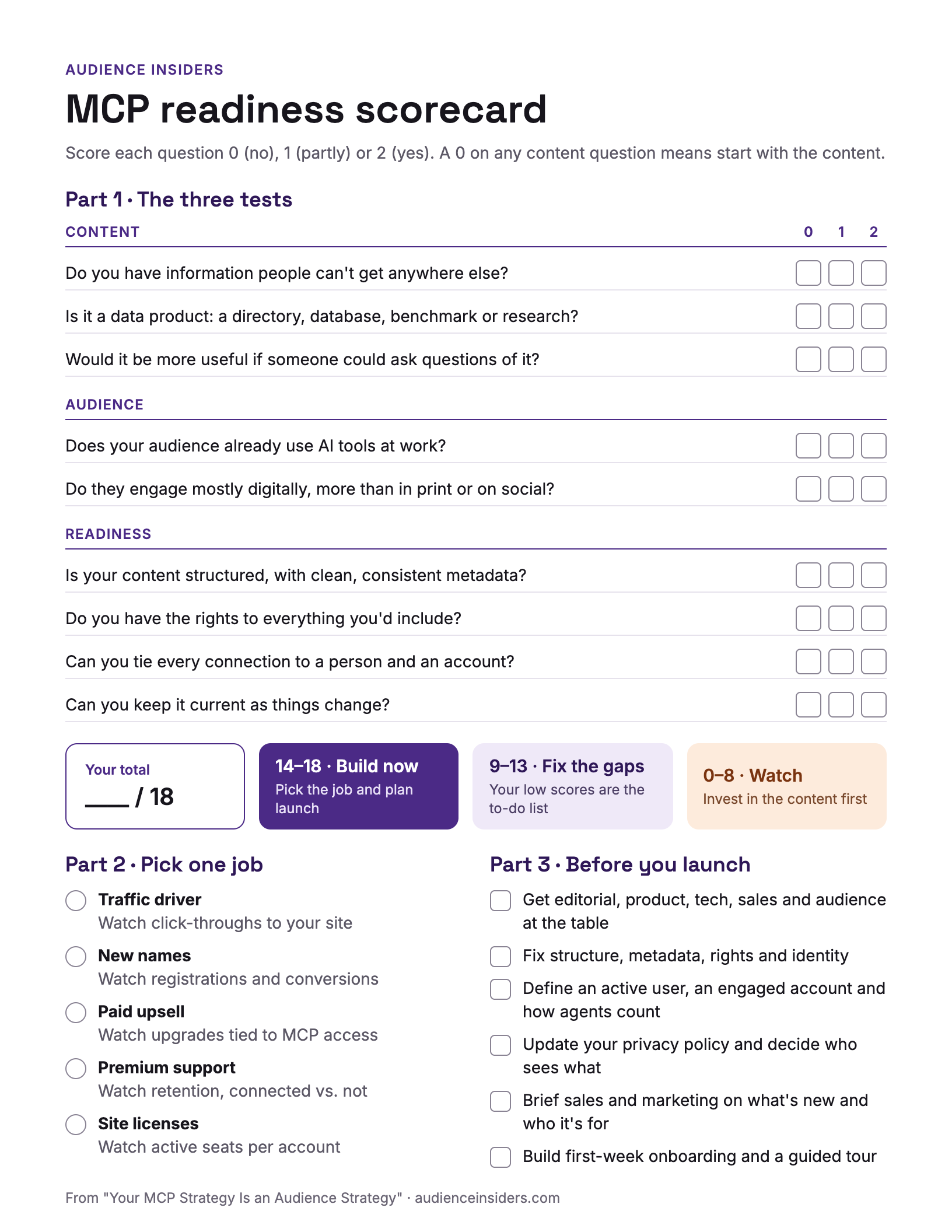
- Run the three tests. Be honest about whether your content and your audience are ready, and list what has to be fixed first.
- Pick the job. Choose which of the five jobs matters most, and set baseline expectations for what it will do.
- Fix the foundation. Clean up structure and metadata, clear the rights, and make sure you can tie every connection to a person and an account.
- Decide what you'll measure. Define an active user, an engaged account, and how you'll count agents before the data shows up.
- Write the privacy rules. Update your policy and decide who sees what.
- Brief the sales and marketing teams. Make sure they know what's part of this, what's new, and who it's for.
- Plan the first week. Build the onboarding and the guided tour before you launch.
The MCP won't replace the rest of your audience strategy. Your site, your newsletters, and your events still matter. But for publishers with content people can't get anywhere else, it's about to become one of the most important places your audience shows up.
If your best customer connected you to their AI tools tomorrow, what would they find that they can't get anywhere else?
I'm happy to share a PDF of the above, just send me a note at tony@audienceinsiders.com.
Sources
- POLITICO Begins Testing MCP Linking Its Energy Journalism To AI Tools For Professionals — POLITICO
- Politico's MCP Beta Test Is the Right Approach to Bringing Journalism Into AI — A Media Operator
- Politico's recent AI experiments shouldn't be subject to newsroom editorial standards, its editors testify — Nieman Lab